
Effects of Navy sonar on whales and dolphins in the Hawaiian Islands: some data, some speculation, some gaps..
Presentation to the Hawaiian Islands Humpback Whale National Marine Sanctuary Advisory Council (virtual event) .
More details
Collapse details
Date Published:
- September 15, 2020
- 5,898.74 KB
Site fidelity, spatial use, and behavior of dwarf sperm whales in Hawaiian waters: using small-boat surveys, photo-identification, and unmanned aerial systems to study a difficult-to-study species.
Marine Mammal Science. 2021.
326-348
More details
Collapse details
Date Published:
Publication:Ocean:Region:Species:Methods:
- August 24, 2021
Dwarf sperm whales (Kogia sima) have been studied rarely at sea. We used photo-identification, boat- and drone-based behavioral observations, and citizen science photo contributions to examine site fidelity, spatial use, and behavior in Hawaiʻi. Sighting rates were highest in island slope (500–1,000 m) waters. Over 40% of photo-identified individuals were linked by association in the same social network. More than half of the very distinctive individuals were seen more than once, and 28.5% were seen in multiple years, with one individual seen 14 times over a 15-year span. Resighted individuals and those in the main cluster of the social network were found in significantly shallower water than individuals that were not resighted or that were in isolated clusters. Distances between resighting locations suggest small home ranges. This suggests an insular slope-dwelling population that overlaps with an offshore population. Evidence of unsuccessful predatory attempts by large sharks was recorded on four individuals, and linear wounds consistent with interactions with line fisheries were documented on three individuals. Surface and subsurface behavior recorded by drone revealed vigilance behavior likely to minimize predation risk. Lessons learned from this study can be applied elsewhere to increase knowledge of this poorly known and difficult-to-study species.
More details
Collapse details
Date Published:
Filesize:
- February 1, 2014
Passive acoustic monitoring was conducted within the Navy’s Cherry Point OPAREA during August – December 2011 and July – October 2012 for a total of 105 and 81 days respectively. This site is located approximately 100 miles from the North Carolina coastline on the shelf break. The 2011 deployment was at a water depth of 952 m and the 2012 deployment was at a water depth of 914 m. Acoustic data collected at this site provide information on the presence of marine mammals and anthropogenic sound sources. High-frequency Acoustic Recording Packages (HARPs) recorded sounds between 10 Hz and 100 kHz with recording cycles of 5 minutes every 10 minutes. The data were divided into three frequency bands and data were analyzed by scans of long-term spectral averages and spectrograms. Four baleen whale species were recorded: blue, fin, minke, and sei whales. The detections of their calls were made between late August and early December 2011. Blue whale calls were the only baleen whale call type detected in the 2012 deployment. No Bryde’s, humpback, or North Atlantic right whale calls were detected in either deployment. Several different toothed whale species were recorded: Blainville’s, Cuvier’s, and Gervais’ beaked whales, killer whales, pygmy or dwarf sperm whales (Kogia spp.), Risso’s dolphins, sperm whales, and unidentified odontocetes. All species except killer whales were recorded in 2011 and 2012. Killer whales were detected only in 2011. Ship noise was the most common anthropogenic sound in both deployments. MFA was noted during both deployments. A total of 391 pings were detected in 2011 with a maximum peak-to-peak received level of 156 dB re 1 μPa. In 2012, a total of 492 pings were detected with a maximum peak-to-peak received level of 167 dB re 1 μPa. Few echosounder pings over a variety of frequencies (4-80 kHz) were detected during both deployments. Explosions were detected in both deployments, though they were more prevalent in 2011 than 2012. High noise levels, possibly caused by instrument strumming and fluid flow at the sensor, occurred intermittently in both deployments and likely decreased the detection range for low-frequency sounds. This strumming was most prevalent in 2012.
- 13,075.42 KB
More details
Collapse details
Date Published:
Filesize:
- September 1, 2016
To monitor for the presence of marine mammals, High-frequency Acoustic Recording Packages (HARPs) were deployed at two sites within the Navy’s Virginia Capes Range Complex. There were three deployments at one site, located offshore from Cape Hatteras (HAT), between October 2012 and December 2014. There was one deployment at the other site, located offshore from Norfolk Canyon (NFC), between June 2014 and April 2015. Both sites were located approximately 75 nmi offshore in about 1000 m of water.
- 13,765.01 KB
More details
Collapse details
Date Published:
Filesize:
- March 1, 2016
A High-frequency Acoustic Recording Package (HARP) was deployed from August 2014 to July 2015, with recordings made between August 2014 and May 2015, to detect marine mammal and anthropogenic sounds in the Navy’s Jacksonville Range Complex. The HARP was located 83 nm off the Florida coastline on the continental slope.
- 6,460.28 KB
More details
Collapse details
Date Published:
Filesize:
- January 1, 2018
Passive acoustic monitoring was conducted using High-frequency Acoustic Recording Packages (HARPs) deployed in waters offshore of Virginia, North Carolina, and Florida with support from the US Navy during 2016 - 2017. The HARPs recorded underwater sounds between 10 Hz and 100 kHz. Data analysis consisted of analyst scans of long-term spectral averages (LTSAs) and spectrograms, and automated computer algorithm detection when possible. Three frequency bands were analyzed for marine mammal vocalizations and anthropogenic sounds: (1) Lowfrequency, between 10-1000 Hz, (2) Mid-frequency, between 1,000-5,000 Hz, and (3) Highfrequency, between 1-100 kHz.
- 5,208.04 KB
- Blue whale
- Bryde's whale
- Fin whale
- Minke whale
- North Atlantic right whale
- Sei whale
- Atlantic white-sided dolphin
- Blainville's beaked whale
- Bottlenose dolphin
- Clymene dolphin
- Common dolphin
- Goose-beaked whale
- Dwarf sperm whale
- False killer whale
- Gervais' beaked whale
- Killer whale
- Northern bottlenose whale
- Risso's dolphin
- Rough-toothed dolphin
- Short-finned pilot whale
- Sowerby's beaked whale
- Sperm whale
- Spotted dolphin
- Striped dolphin
Cetacean Research in the Marianas.
NMFS-PIFSC External Program Review of Protected Species Science .
More details
Collapse details
Date Published:
Filesize:
- April 16, 2026
Goals: Understand species occurrence and distribution. Determine the population structure and abundance of the those species. Study the movements and habitat use of individuals and populations. Methods: Small boat-based and ship-based surveys. Passive acoustic recordings (HARPs & towed array). Photo-ID, biopsy sampling, and satellite tagging.
- 5,971.92 KB
More details
Collapse details
Date Published:
Filesize:
- January 1, 2013
A High-frequency Acoustic Recording Package (HARP; Wiggins and Hildebrand 2007) was deployed between July 2010 and June 2011 in Onslow Bay at Site A in 171 m. This HARP sampled at 200 kHz for 5 minutes of every 10 minutes and recorded for 216 days between 30 July 2010 and 3 March 2011. Long-Term Spectral Averages (LTSAs) were created for two frequency bands (10 Hz – 1000 Hz and 1 kHz – 100 kHz) and scanned for marine mammal vocalizations. Calls of blue whales, fin whales, minke whales, North Atlantic right whales, possible sei whales, Kogia spp., Risso’s dolphins, sperm whales, and unidentified delphinids were detected in the data.
- 1,673.75 KB
More details
Collapse details
Date Published:
Filesize:
- January 1, 2014
A High-frequency Acoustic Recording Package (HARP; Wiggins and Hildebrand 2007) was deployed between July and October 2012 in Onslow Bay at Site E in 914 m. This HARP sampled at 200 kHz for 5 minutes of every 10 minutes and recorded for 81 days between 14 July 2012 and 2 October 2012. Long-Term Spectral Averages (LTSAs) were created for three frequency bands (10 Hz – 1000 Hz, 500 Hz – 5000 Hz, and 1 kHz – 100 kHz) and scanned for marine mammal vocalizations. Calls of blue whales, Blainville’s beaked whales, Cuvier’s beaked whales, Gervais’ beaked whales, Kogia spp., Risso’s dolphins, sperm whales, and unidentified delphinids were detected in the data.
- 1,321.32 KB
More details
Collapse details
Date Published:
Filesize:
- January 1, 2014
A High-frequency Acoustic Recording Package (HARP; Wiggins and Hildebrand 2007) was deployed between August 2011 and July 2012 in Onslow Bay at Site E in 952 m. This HARP sampled at 200 kHz for 5 minutes of every 10 minutes and recorded for 105 days between 19 August 2011 and 1 December 2011. Long-Term Spectral Averages (LTSAs) were created for three frequency bands (10 Hz – 1000 Hz, 500 Hz – 5000 Hz, and 1 kHz – 100 kHz) and scanned for marine mammal vocalizations. Calls of blue whales, fin whales, minke whales, possible sei whales, an unidentified beaked whale species, Blainville’s beaked whales, Cuvier’s beaked whales, Gervais’ beaked whales, killer whales, Kogia spp., Risso’s dolphins, sperm whales, and unidentified delphinids were detected in the data.
- 1,903.07 KB
More details
Collapse details
Date Published:
Filesize:
- January 1, 2014
A High-frequency Acoustic Recording Package (HARP; Wiggins and Hildebrand 2007) was deployed between July 2010 and February 2011 in Onslow Bay at Site D in 338 m. This HARP sampled at 200 kHz for 5 minutes of every 10 minutes and recorded for 210 days between 30 July 2010 and 24 February 2011. Long-Term Spectral Averages (LTSAs) were created for two frequency bands (10 Hz – 1000 Hz and 1 kHz – 100 kHz) and scanned for marine mammal vocalizations. Calls of blue whales, fin whales, minke whales, possible sei whales, Kogia spp., Risso’s dolphins, sperm whales, and unidentified odontocetes were detected in the data.
- 3,241.19 KB
More details
Collapse details
Date Published:
Filesize:
- January 1, 2014
A High-frequency Acoustic Recording Package (HARP; Wiggins and Hildebrand 2007) was deployed between November 2009 and April 2010 in Onslow Bay at Site C in 335 m. This HARP sampled at 200 kHz for 5 minutes of every 15 minutes and recorded for 163 days between 8 November 2009 and 20 April 2010. Long-Term Spectral Averages (LTSAs) were created for two frequency bands (10 Hz – 1000 Hz and 1 kHz – 100 kHz) and scanned for marine mammal vocalizations. Calls of blue whales, fin whales, minke whales, humpback whales, possible sei whales, Kogia spp., Risso’s dolphins, sperm whales, and unidentified delphinids were detected in the data.
- 1,526.63 KB
More details
Collapse details
Date Published:
Filesize:
- January 1, 2014
A High-frequency Acoustic Recording Package (HARP; Wiggins and Hildebrand 2007) was deployed between November 2009 and February 2010 in Onslow Bay at Site A in 171 m. This HARP sampled at 200 kHz for 5 minutes of every 15 minutes and recorded for 108 days between 8 November 2009 and 24 February 2010. Long-Term Spectral Averages (LTSAs) were created for two frequency bands (10 Hz – 1000 Hz and 1 kHz – 100 kHz) and scanned for marine mammal vocalizations. Calls of blue whales, fin whales, minke whales, possible sei whales, Kogia spp., Risso’s dolphins, sperm whales, and unidentified delphinids were detected in the data.
- 1,373.54 KB
More details
Collapse details
Date Published:
Filesize:
- April 3, 2015
A High-frequency Acoustic Recording Package (HARP; Wiggins and Hildebrand 2007) was deployed between October 2012 and August 2013 in Onslow Bay at Site E in 853 m. This HARP sampled at 200 kHz for 5 minutes of every 10 minutes and recorded for 250 days between 24 October 2012 and 30 June 2013. Long-Term Spectral Averages (LTSAs) were created for three frequency bands (10 Hz – 1000 Hz, 500 Hz – 5000 Hz, and 1 kHz – 100 kHz) and scanned for marine mammal vocalizations. Calls of blue whales, fin whales, minke whales, possible sei whales, Blainville’s beaked whales, Cuvier’s beaked whales, Gervais’ beaked whales, Kogia spp., Risso’s dolphins, sperm whales, and unidentified odontocetes and mysticetes were detected in the data.
- 2,799.53 KB
More details
Collapse details
Date Published:
Filesize:
- January 1, 2014
A High-frequency Acoustic Recording Package (HARP; Wiggins and Hildebrand 2007) was deployed between April and September 2009 in Onslow Bay at Site A in 174 m. This HARP sampled at 200 kHz for 5 minutes of every 10 minutes and recorded for 107 days between 24 April 2009 and 9 August 2009. Long-Term Spectral Averages (LTSAs) were created for two frequency bands (10 Hz – 1000 Hz and 1 kHz – 100 kHz) and scanned for marine mammal vocalizations. Vocalizations of Kogia spp., Risso’s dolphins, sperm whales, and unidentified delphinids were detected in the data.
- 977.21 KB
More details
Collapse details
Date Published:
Filesize:
- January 1, 2013
A High-frequency Acoustic Recording Package (HARP; Wiggins and Hildebrand 2007) was deployed between March and October 2012 in the Cape Hatteras survey area at Site A in approximately 950 m. This HARP sampled continuously at 200 kHz and recorded for 28 days between 15 March 2012 and 11 April 2012. Long-Term Spectral Averages (LTSAs) were created for two frequency bands (10 Hz – 1000 Hz and 1 kHz – 100 kHz) and scanned for marine mammal vocalizations. Calls of fin whales, minke whales, beaked whales, Kogia spp., Risso’s dolphins, sperm whales, and unidentified delphinids were detected in the data.
- 370.58 KB
Passive Acoustic Monitoring for Marine Mammals at Site A in Onslow Bay, October 2007 – January 2008.
More details
Collapse details
Date Published:
Filesize:
- January 1, 2014
A High-frequency Acoustic Recording Package (HARP; Wiggins and Hildebrand 2007) was deployed between October 2007 and May 2008 in Onslow Bay at Site A in 162 m. This HARP sampled at 200 kHz for 5 minutes of every 10 minutes, with the exception of the period from January 1 – 16, 2008, when it recorded continuously due to an instrumentation malfunction, and recorded for 98 days between 10 October 2007 and 16 January 2008. Long-Term Spectral Averages (LTSAs) were created for two frequency bands (10 Hz – 1000 Hz and 1 kHz – 100 kHz) and scanned for marine mammal vocalizations. Calls of blue whales, fin whales, minke whales, possible sei whales, Kogia spp., Risso’s dolphins, sperm whales, and unidentified delphinids were detected in the data.
- 1,395.18 KB
More details
Collapse details
Date Published:
Filesize:
- January 1, 2014
A High-frequency Acoustic Recording Package (HARP; Wiggins and Hildebrand 2007) was deployed between May and November 2008 in Onslow Bay at Site B in 232 m. This HARP sampled at 200 kHz for 5 minutes of every 10 minutes and recorded for 103 days between 30 May 2008 and 10 September 2008. Long-Term Spectral Averages (LTSAs) were created for two frequency bands (10 Hz – 1000 Hz and 1 kHz – 100 kHz) and scanned for marine mammal vocalizations. Vocalizations of blue whales, Kogia spp., Risso’s dolphins, sperm whales, and unidentified delphinids were detected in the data.
- 1,109.07 KB
More details
Collapse details
Date Published:
Filesize:
- April 1, 2016
A High-frequency Acoustic Recording Package (HARP; Wiggins and Hildebrand 2007) was deployed between August 2014 and July 2015 in the Jacksonville, FL, survey area at Site D in 806 m. This HARP sampled continuously at 200 kHz and recorded for 279 days between 23 August 2014 and 29 May 2015. The data were divided into three frequency bands (10 Hz – 1000 Hz, 500 Hz – 5000 Hz, and 1 kHz – 100 kHz) and scanned manually for marine mammal vocalizations using Long-Term Spectral Averages (LTSAs) and automated computer algorithm detection when possible. Vocalizations of fin whales, minke whales, sei whales, Kogia spp., Risso’s dolphins, sperm whales, Blainville’s beaked whales, Gervais’ beaked whales, and unidentified delphinids were detected in the data.
- 1,876.70 KB
More details
Collapse details
Date Published:
Filesize:
- June 1, 2017
The U.S. Navy has been using High-frequency Acoustic Recording Packages (HARPs) to conduct passive acoustic monitoring in waters offshore of Virginia, North Carolina, and Florida to determine patterns of occurrence and distribution of cetacean species and anthropogenic sounds since 2007. The datasets discussed in this annual report came from seven HARP deployments made from 2012 through 2016: one near Norfolk Canyon, off the coast of Virginia (982 meter [m] depth) between June 2014 and April 2015; four off Cape Hatteras, North Carolina (850–980 m depths) between October 2012 and April 2016; and two off Jacksonville, Florida (800–806 m depths) between August 2014 and April 2016.
- 7,021.28 KB
More details
Collapse details
Date Published:
Filesize:
- August 17, 2016
A High-frequency Acoustic Recording Package (HARP; Wiggins and Hildebrand 2007) was deployed between May 2014 and April 2015 in the Cape Hatteras, NC, survey area at Site A in 850 m. This HARP sampled continuously at 200 kHz and recorded for 217 days between 9 May 2014 and 11 December 2014. The data were divided into three frequency bands (10 Hz – 1000 Hz, 500 Hz – 5000 Hz, and 1 kHz – 100 kHz) and scanned for marine mammal vocalizations using Long-Term Spectral Averages (LTSAs) and automated detectors. Vocalizations of blue whales, fin whales, minke whales, sei whales, North Atlantic right whales, humpback whales, Kogia spp., Risso’s dolphins, sperm whales, Cuvier’s beaked whales, Gervais’ beaked whales, Blainville’s beaked whales, and unidentified delphinids were detected in the data.
- 2,212.30 KB
More details
Collapse details
Date Published:
Filesize:
- August 17, 2016
A High-frequency Acoustic Recording Package (HARP; Wiggins and Hildebrand 2007) was deployed between May 2013 and March 2014 in the Cape Hatteras, NC, survey area at Site A in 970 m. This HARP sampled continuously at 200 kHz and recorded for 290 days between 29 May 2013 and 15 March 2014. The data were divided into three frequency bands (10 Hz – 1000 Hz, 500 Hz – 5000 Hz, and 1 kHz – 100 kHz) and scanned for marine mammal vocalizations using Long-Term Spectral Averages (LTSAs) and automated detectors. Vocalizations of blue whales, fin whales, minke whales, sei whales, North Atlantic right whales, humpback whales, Kogia spp., Risso’s dolphins, sperm whales, Cuvier’s beaked whales, Gervais’ beaked whales, Blainville’s beaked whales, possible Sowerby’s beaked whales, and unidentified delphinids were detected in the data.
- 2,842.35 KB
More details
Collapse details
Date Published:
Filesize:
- August 16, 2016
A High-frequency Acoustic Recording Package (HARP; Wiggins and Hildebrand 2007) was deployed between October 2012 and May 2013 in the Cape Hatteras, NC, survey area at Site A in 970 m. This HARP sampled continuously at 200 kHz and recorded for 212 days between 9 October 2012 and 9 May 2013. The data were divided into three frequency bands (10 Hz – 1000 Hz, 500 Hz – 5000 Hz, and 1 kHz – 100 kHz) and scanned for marine mammal vocalizations using Long-Term Spectral Averages (LTSAs) and automated detectors. Vocalizations of blue whales, fin whales, minke whales, sei whales, North Atlantic right whales, humpback whales, Kogia spp., Risso’s dolphins, sperm whales, Cuvier’s beaked whales, Gervais’ beaked whales, Blainville’s beaked whales, and unidentified delphinids were detected in the data.
- 2,669.81 KB
More details
Collapse details
Date Published:
Filesize:
- August 16, 2016
A High-frequency Acoustic Recording Package (HARP; Wiggins and Hildebrand 2007) was deployed between June 2014 and April 2015 in Norfolk Canyon, VA, at Site A in 982 m. This HARP sampled continuously at 200 kHz and recorded for 290 days between 19 June 2014 and 5 April 2015. The data were divided into three frequency bands (10 Hz – 1000 Hz, 500 Hz – 5000 Hz, and 1 kHz – 100 kHz) and scanned for marine mammal vocalizations using Long-Term Spectral Averages (LTSAs) and automated detectors. Vocalizations of blue whales, fin whales, minke whales, sei whales, humpback whales, Kogia spp., Risso’s dolphins, sperm whales, Cuvier’s beaked whales, Gervais’ beaked whales, possible Sowerby’s beaked whales, and unidentified delphinids were detected in the data.
- 2,844.76 KB
Heard but not seen: Occurrence of Kogia spp. along the western North Atlantic shelf break.
Marine Mammal Science. 2018.
34: 1141-1153
More details
Collapse details
Date Published:
Publication:Ocean:Region:Species:
- March 15, 2018
The two species in the family Kogiidae, the pygmy (Kogia breviceps) and dwarf (K. sima) sperm whales, are found worldwide in tropical and temperate waters (Jefferson et al. 1993). These cryptic species (hereafter referred to as Kogia) are difficult to detect during visual surveys due to their small size and inconspicuous surfacing behavior (McAlpine 2009). When sighted, both species are found in small groups (Jefferson et al. 1993) and avoid vessels (Würsig et al. 1998). They do not show their flukes when they dive (McAlpine 2009) and sometimes merely sink from the surface (Willis and Baird 1998). Their blow is seldom visible, and they often lie motionless at the surface (Leatherwood et al. 1976, McAlpine 2009).
More details
Collapse details
Date Published:
Filesize:
- June 1, 2017
Ten bottom mounted passive acoustic recorders are deployed off the coast of Virginia and will be maintained for two years. A combination of high-frequency Autonomous Multichannel Acoustic Recorders (AMAR), and low-frequency Marine Autonomous Recording Units (MARU) was deployed in two spatial configurations with the AMARs in a linear array extending east from the mouth of the Chesapeake Bay across the continental shelf, and MARUs deployed as a synchronized localization array within the WEA.
- 1,390.95 KB
More details
Collapse details
Date Published:
- October 1, 2018
Dwarf sperm whale (Kogia sima) echolocation clicks from Guam (Western North Pacific Ocean).
Journal of the Acoustical Society of America. 2016.
140(4, Part 2):3415
More details
Collapse details
Date Published:
Publication:Ocean:Region:Species:Methods:
- October 1, 2016
The cryptic species of the genus Kogia, including the dwarf sperm whale (Kogia sima) and the pygmy sperm whale (Kogia breviceps), are very difficult to observe in any but the most calm sea conditions. However, recordings of signals from wild and captive animals reveal that they echolocate at high frequencies (peak frequencies > 100 kHz) which makes passive acoustic monitoring (PAM) a possibility. We present details from a recent encounter with K. sima in the wild near the island of Guam (Western North Pacific Ocean). Three individuals were observed during a small-boat, visual survey in May 2016, and recordings were collected using a Compact Acoustic Recording Buoy (CARB). These clicks, with mean peak frequency of 126 kHz ( + /- 4.3 kHz), mean click duration of 72 us ( + /- 21 us), and -3 dB bandwidth 5.5 kHz ( + /- 1.6 kHz), had similar properties to recordings of wild K. sima from the Bahamas (Atlantic Ocean), and also appear similar to published recordings from K. breviceps (Madsen et al. 2005). Available data and analyses to date do not allow for absolute determination between the two Kogia species at this time, but recordings such as these bring us closer to definitive species classification.
More details
Collapse details
Date Published:
Filesize:
- April 1, 2016
In 2015 field efforts were carried out at the U.S. Navy’s Atlantic Undersea Test and Evaluation Center (AUTEC) during two time periods prior to the spring and fall Submarine Commander Courses (SCC). The tests were conducted under the auspice of the Living Marine Resources Program (LMR) and the Office of Naval Research (ONR). The first took place April 23rd – May 11th, and the second October 24th – November 6th. There was an additional test conducted from August 10th – 23rd when range activity was low and weather conditions are generally better, thus maximizing the opportunities for locating and tagging beaked whales to gather baseline data.
- 267.04 KB
More details
Collapse details
Date Published:
Filesize:
- September 9, 2024
We report significant pathological findings from 250 stranding investigations of 20 cetacean species in the Pacific Islands region between 2006 and 2022. Full or partial necropsies of 196 of the 250 stranding cases (78.4%) resulted in a diagnosis or multiple diagnoses associated with death in 126 cases. Natural disease accounted for 60.3% of stranded animals; approximately half were in poor body condition at time of death due to chronic illness. Morbillivirus and Brucella sp. infections caused mortality in eleven species, including striped dolphins and the Longman’s beaked whale. Toxoplasma infection, of anthropogenic cause in Hawaiʻi, led to the deaths of two spinner dolphins. Pygmy and dwarf sperm whales, beaked whales and pilot whales showed heavy parasitism by nematodes, cestodes and trematodes. Approximately 12.7% of stranded individuals were perinates/neonates, with three cases of dystocia with maternal mortality. Anthropogenic trauma was observed in 30.2% of strandings. In seven Cuvier’s beaked whales, cranial and/or microvascular hemorrhages were categorized as trauma. Vertebral and skull fractures were attributed to direct vessel strikes for two pygmy sperm whales, a Cuvier’s beaked whale, a humpback whale calf and a striped dolphin. Blast trauma was observed in three Fraser’s dolphins that were part of an uncommon stranding event. Significant plastic debris, and/or fishery debris were found in stomachs of six species and fatal fishhook penetration occurred in a Submitted in Support of the U.S. Navy’s 2023 Annual Marine Species Monitoring Report for the Pacific STANDARD FORM 298 Back (Rev. 8/98) bottlenose dolphin. This study highlights the value of carcass examinations in a region inhabited by small island associated populations where carcass recovery rates are low, and cetaceans face an array of natural and anthropogenic threats.
- 1,496.52 KB
- Humpback whale
- Blainville's beaked whale
- Bottlenose dolphin
- Goose-beaked whale
- Dwarf sperm whale
- False killer whale
- Fraser's dolphin
- Killer whale
- Longman’s beaked whale
- Melon-headed whale
- Pilot whale
- Pygmy killer whale
- Risso's dolphin
- Rough-toothed dolphin
- Short-finned pilot whale
- Sperm whale
- Spinner dolphin
- Spotted dolphin
- Striped dolphin
More details
Collapse details
Date Published:
Filesize:
- November 11, 2024
This review examines historical data from 535 odontocete stranding events in the Mariana archipelago and Hawaiian Islands by date, location and species and spans the time period of 1848 to 2023. Reports of strandings increased across the two geographic regions that were generally consistent over time. A total of 54 historical stranding events that represent 14 odontocete species are described for the Mariana Islands. A total of 481 stranding events that represent 19 odontocete species are described from the Hawaiian Islands, significantly updating the last published report that examined 202 odontocete strandings that occurred in the main Hawaiian Islands between 1937 and 2002. ArcGIS cluster maps were utilized to identify groupings of stranding events across the geographic regions. The majority of strandings in the Mariana Islands were reported from the west and southeastern coast of Guam, followed by Saipan, Rota and Tinian. Stranding hotspots in the Hawaiian Islands were identified at Mā’alaea Bay, Maui, at windward Oʻahu and near Kailua-Kona on Hawaiʻi Island.
- 493.28 KB
More details
Collapse details
Date Published:
Filesize:
- September 16, 2024
This project provides support for comprehensive stranding investigations in order to obtain increased baseline information about the health of marine mammals. Such support is essential when considering the Pacific Islands region (PIR) where unique geographical challenges exist. The PIR is comprised of isolated islands, spanning over 4 million square miles across the North, South and Western Pacific basins and includes the Hawai‘i Range Complex and the Mariana Islands Range Complex. All cetacean stranding response and investigative efforts for the PIR are centralized at a dedicated stranding facility located at Marine Corps Base Hawai‘i (MCBH). This specialized facility houses the University of Hawai‘i (UH) Health and Stranding Lab, which plays a critical role as the only organization in the region to conduct cause of death investigations when dolphins and whales strand. This requires mounting an immediate response to each newly reported stranding event that occurs and conducting extensive necropsy examinations, including histopathology, disease surveillance, and tissue sampling in support of numerous research efforts aimed at better understanding Hawaiian cetaceans. In addition to this project facilitating advanced diagnostics in-house at the Health and Stranding Lab, we also report on progress towards a project option to measure fecal stress and reproductive hormones in Pacific Island cetaceans. An additional project option includes characterizing marine debris ingestion by abundance and mass in previously stranded short-finned pilot whales.
- 1,446.02 KB
Current
Acoustic Ecology of Northwest Atlantic Shelf Break Cetaceans and Effects of Anthropogenic Noise Impacts
Project Objectives
Assess the acoustic niche of marine mammal species and anthropogenic contributors to disturbance
Current
Atlantic Behavioral Response Study
Project Objectives
Assess behavioral response of beaked and pilot whales to mid-frequency tactical sonar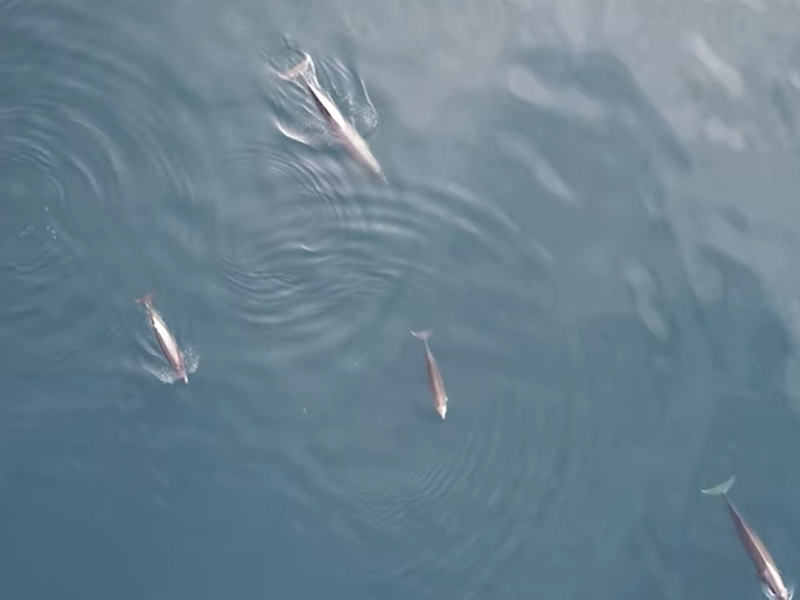
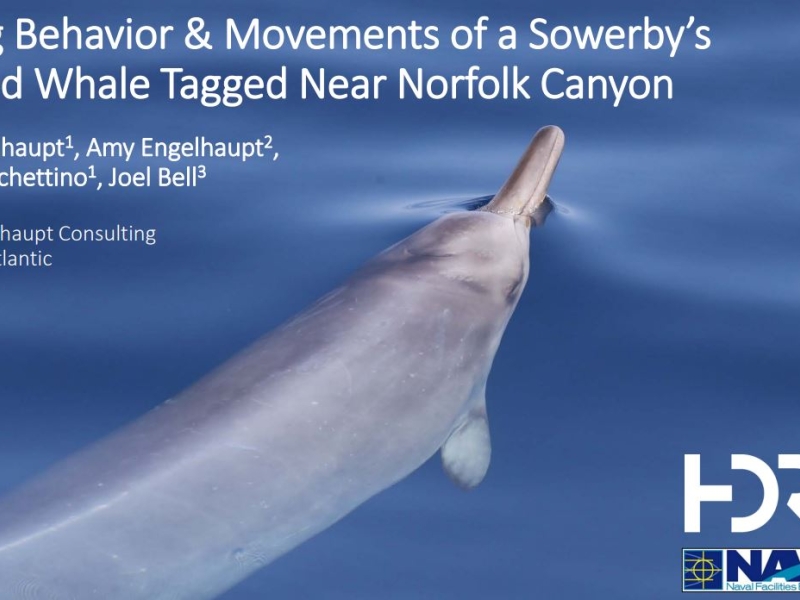
Sowerby's beaked whales encountered at Norfolk Canyon
January 7, 2019
Excellent drone footage of a group of rarely seen beaked whales.
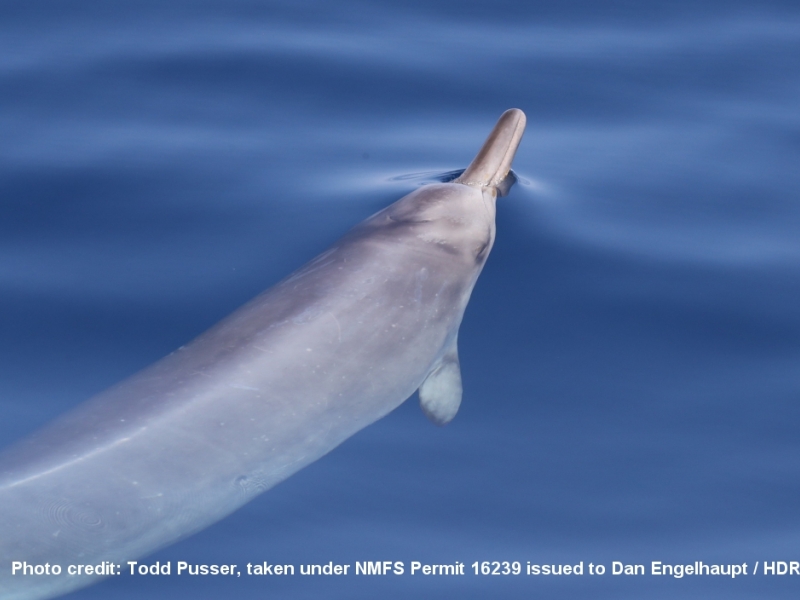
Sowerby's beaked whale tagged offshore of Virginia
September 12, 2018
A rarely seen beaked whale was tracked offshore.